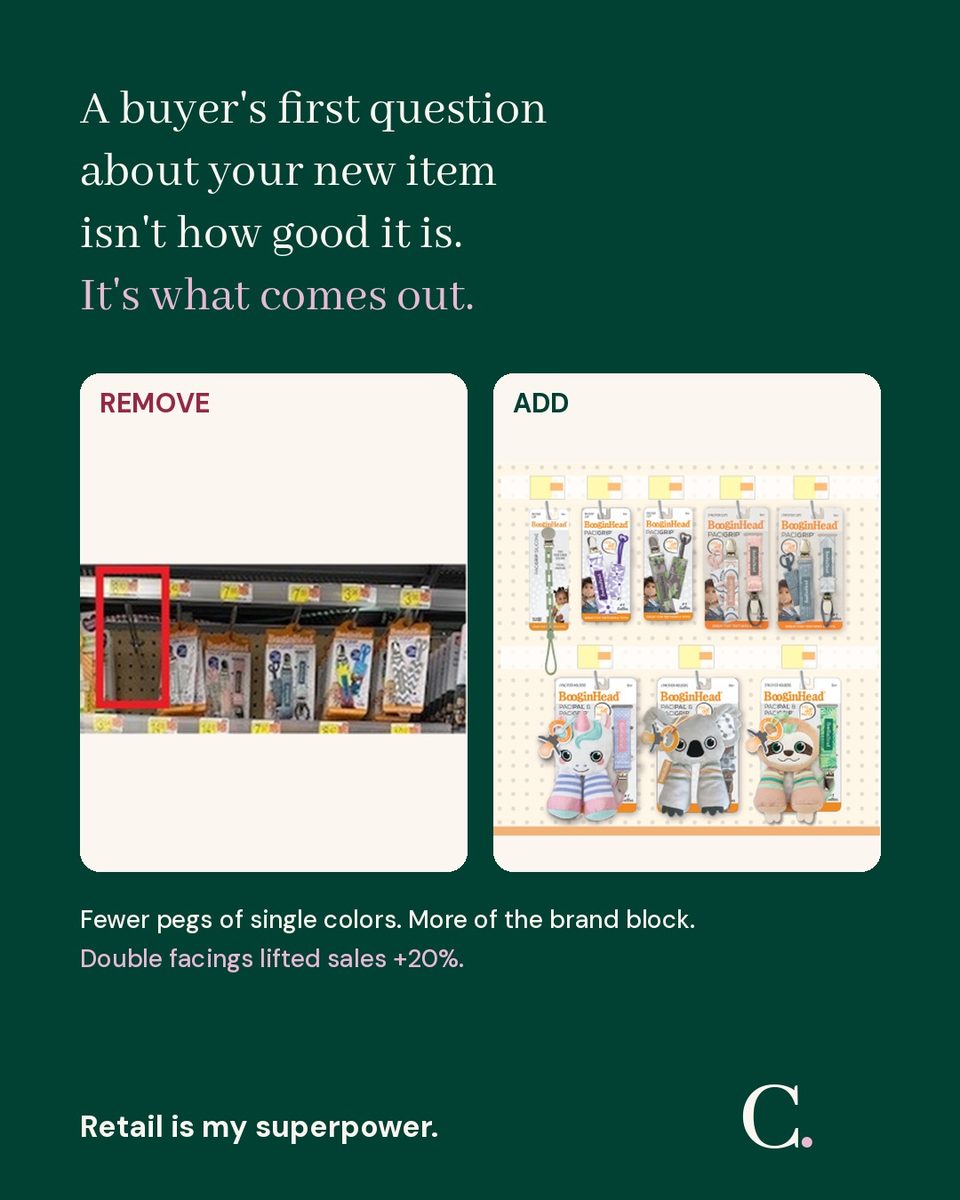
A buyer’s first question about your new item isn’t how good it is. It’s what comes out to make room for it.
In every line review deck, I made sure they had the whole picture before they asked.
We built a mockup of what our items would look like on the shelf we were presenting. We photographed the current set. We marked which items would come off to make room, with data to back each one up.
One time, one of our items sold below the expected threshold. There was a clear gap between that and our other items, and we knew we had to address it. Sometimes it isn’t just about fighting for your item but helping the buyer make the right decision and getting ahead of what you know may be the outcome regardless. That’s also where trust and open communication are built.
Sometimes one of mine came out; sometimes it was someone else. That’s how it works. But there were also times we earned new pegs because we brought research showing why that peg would perform better than what was already on the shelf. That’s called identifying the whitespace, and it goes hand in hand with knowing your category.
Here’s why it works. A buyer has a fixed amount of shelf space, and many people are asking for part of it. If you walk in with only your product, they have to decide what to pull, and they’ll decide without your data. If you walk in with the picture of the shelf, the swap, and the proof, you’ve already done the hardest part of their job.
So, before your next line review, make two things. A photo of the current set. And a mockup of the new one, with a reason for every item that moves.
Retail is my superpower.